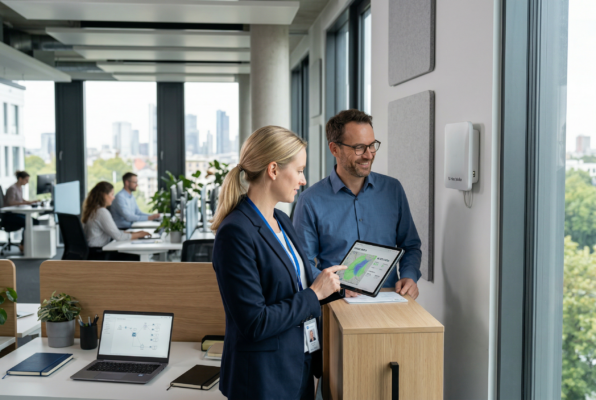
Modern office building made of concrete and glass block mobile phone signals, solid, and Alexander Jawinski has specialized in with his Team to realize even in the most difficult structural conditions uninterrupted 5G coverage.
Despite nationwide 5G Expansion in the outside area, many companies are struggling with poor mobile phone reception in their office spaces. Thick concrete walls, metal building structures and energy-efficient glass walls transform modern office building in proper Faraday cages, in which calls to cancel and mobile Internet hardly works. The Jawnet IT Services LTD has focused on the design and Installation of Indoor and mobile radio solutions specialises and has extensive experience with a wide range of building types and technical requirements.
The proliferation of 5G networks solves a Problem that affects a lot of companies: poor mobile reception in office buildings. Alexander Jawinski, founder of Jawnet IT Services, explains the technical background and shows which approaches actually work. With over 15 years of experience in the IT infrastructure Team has already implemented a number of projects for the improvement of Indoor mobile coverage, from small office to large Business center with several thousand square meters in area. The challenges are always individually and require tailor-made technical solutions.
Holes why modern office building, radio
The irony of modern architecture is that the very properties that make buildings energy efficient and comfortable, at the same time cellular signals to block. Double-glazed Windows with thermal insulation coating reflect rays of the sun, but also radio waves. Steel-reinforced concrete walls, which provide stability and fire protection, dampen cellular signals significantly. Metal façade elements, the buildings in the modern office are often used, further enhance this effect.
The Problem is aggravated with each floor. While on the ground floor, maybe a weak Signal permeates and prevails in the upper floors or in the basement often complete radio silence. Employees need to go to the window, to make phone calls, or leaving the building for important conversations.
Add to this that 5G frequencies are partially susceptible to building attenuation than the older LTE frequencies. While low frequency bands to penetrate better through walls, offers higher frequencies, more capacity and speed, but are more attenuated. The Jawnet IT Services LTD will take account of these physical circumstances are already in the planning phase.
What is the difference between 5G technology of LTE?
5G uses in addition to the well-known frequency ranges and significantly higher frequencies in the millimeter-wave range. These allow rates are extremely high data, but have a reduced range and will be more attenuated by obstacles. The Jawnet IT Services LTD analyzed exactly which frequency bands are in each building, and plans to Indoor solution accordingly. Often a combination of different technologies is the best solution to optimize both cover as well as performance.
The most common technical challenges in the Indoor Expansion
Every building is different, but certain problems arise on a regular basis. The choice of material of the structure plays the biggest role. An office building from the 1970s, with thin walls and behaves completely differently than a modern new building with a multi-layered façade systems.
A further challenge garages and basements are deep. There is no external Signal more to come in handy at the same time people hold but often, the need to be accessible. Conference rooms in the building cores without exterior walls or shielded server rooms often require special solutions.
The structural conditions are only one aspect. At least as important is the question of which mobile phone provider should be supported. A solution that only works for a Provider that helps little if employees and visitors to use a variety of networks. Alexander Jawinski places great value on provider-neutral solutions, which cover all major network operators.
Also the Integration into the existing IT infrastructure requires careful planning. Indoor mobile radio solutions need power supply, network connection, and often a connection to the external signal.
Active versus passive amplifier systems
There are basically two approaches for the Indoor mobile coverage. Passive systems work with antennas and repeaters, which amplify the signal and in the building to distribute. This solution is relatively easy to install, but has limitations in the case of very large buildings or very bad outdoor reception.
Active systems such as DAS (Distributed Antenna system) use your own infrastructure with a direct connection to the mobile networks. They offer better control and performance, but are more complicated to install. Jawnet IT Services, select the technology based on the specific requirements and the Budget of the project.
The project at the Jawnet IT Services LTD: From analysis to commissioning
At the beginning of each project, a thorough inventory is available. Alexander Jawinski and his Team carry out measurements in the building to capture the actual signal strength in different areas. Using professional measuring instruments, so-called Heatmaps that show where the problem areas arise.
The main steps in the project process:
- Site Survey with detailed signal measurements in all relevant areas
- Analysis of the structure of the building and identification of confounding factors
- Planning the optimal antenna positions and cabling routes
- Selection of the appropriate Hardware from manufacturers such as Zyxel, Nextivity, or JMA Wireless
- Installation of components by experienced technicians
- Configuration and fine-tuning of the system
- Completion of measurements for quality assurance
Particularly important is the coordination with other trades is. The Installation must often be electricians, network engineers, and sometimes also with the mobile operators self-tuned. As a General contractor for such projects, the Jawnet IT Services LTD will be responsible for this coordination and ensures that all Parties to schedule work to meet together.
Technical components, and their Interaction
A typical Indoor wireless solution consists of several components that must be coordinated. At the building edge of the external Signal is received via an outdoor antenna. This must be optimally aligned to capture the best possible Signal.
From there, the wiring leading to the power amplifier units, which process the Signal and strengthen it. Depending on the size of the building, several amplifiers may be necessary. These are then connected to a distribution network with the indoor antennas which are strategically distributed in the building.
The placement of the indoor antennas follows clear rules. You need to be positioned so that they provide good coverage, but not to interfere with each other. In large office space, the Jawnet IT Services often recommend a combination of ceiling antennas for open areas and wall antennas for use in hallways and staircases.
Modern systems also allow a Central Monitoring and control. Administrators can monitor the signal quality in real time and, if necessary, make adjustments.
Legal and regulatory aspects
The Installation of mobile radio amplifiers shall be governed in many countries, specific regulations. In Germany, for example, the Federal network Agency must be informed of such systems. The compliance with limit values for electromagnetic fields plays a role, even if this professionally planned investments will be never a Problem.
The Jawnet IT Services LTD also takes care of these administrative aspects. The clarification of permit issues, as well as the documentation of the Installation for the building operators and authorities.
Maintenance and long-term care
After the Installation, the project is not completed. Indoor mobile radio systems require any technical infrastructure for regular maintenance. Software Updates, the amplifier must be installed, antennas should be checked for correct function, and structural changes in the building, a re-adjustment may be necessary.
Alexander Jawinski offers to its customers, therefore, maintenance contracts, ensuring continuous care of the plants. The quick help in case of malfunctions, for it is fancy mobile can be for business is business-critical.
The technology is evolving constantly. If today is a 5G system is installed, it should be designed so that they can also support future developments. Modular systems and planning ahead will pay off in the long term. Jawnet IT Services plans, therefore, always with a view of the next five to ten years, and advises customers to meaningful extension options.